
CRI²SPIN’s Cryo FMR system extends ferromagnetic resonance spectroscopy into the cryogenic regime, enabling the study of spin dynamics, magnetic damping, and anisotropy as a function of temperature. Our custom-developed FMR insert is designed to operate inside the Variable Temperature Insert (VTI) of a cryostat, providing a controlled sample environment from room temperature down to below 4 K. Combined with our in-house broadband RF/microwave components and fully integrated measurement software, the system delivers a complete, user-friendly turnkey solution for academic research.

in collaboration with cryogenic ltd.
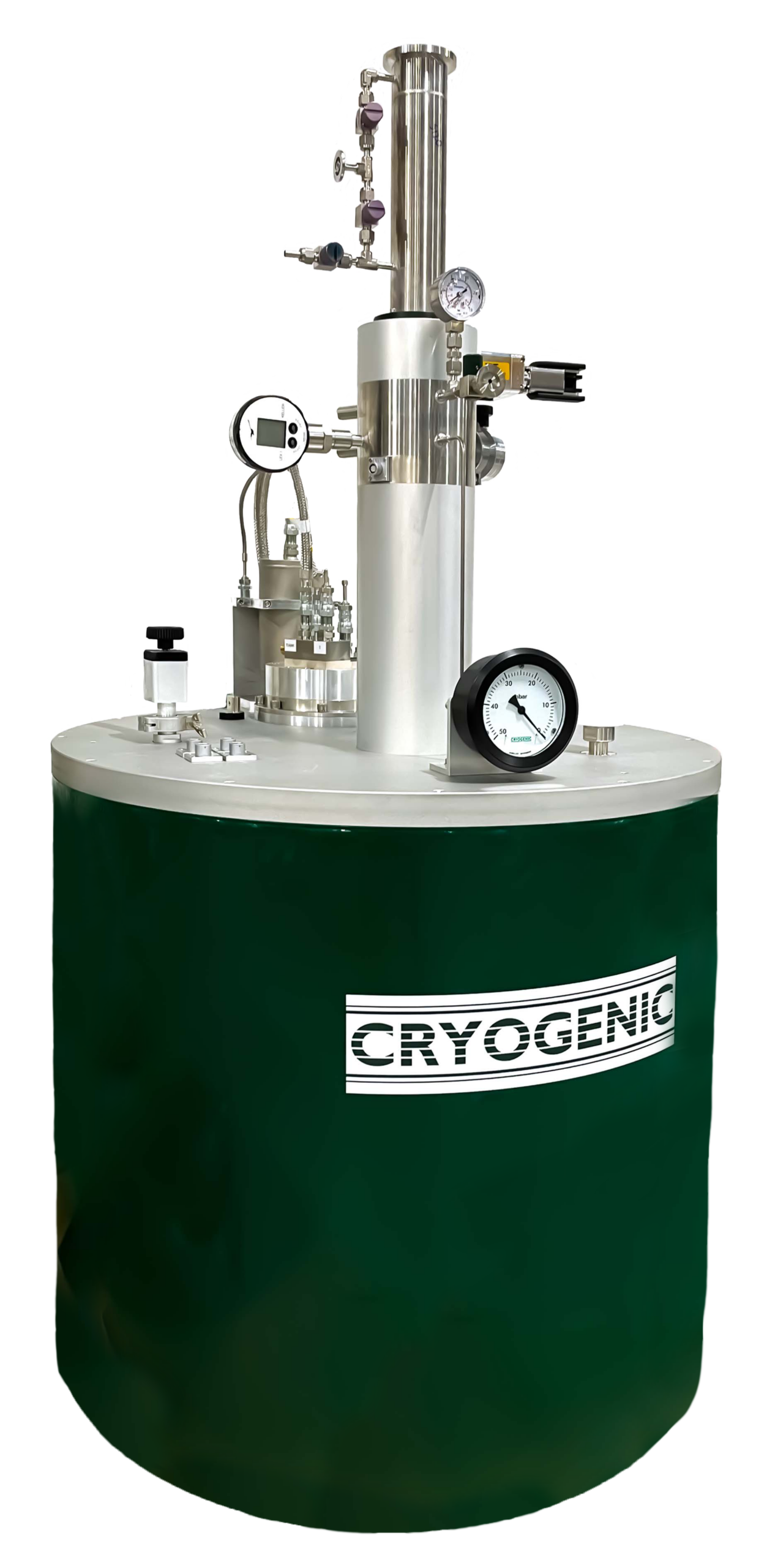
The Cryo FMR system is developed in close collaboration with Cryogenic Ltd., a London-based leader in high-field superconducting magnets and low-temperature measurement systems with over 30 years of experience. Cryogenic Ltd. provides the cryostat platform — including their Variable Temperature Insert (VTI) technology — which forms the cold-stage foundation of our FMR system. CRI²SPIN designs and integrates the FMR-specific RF/microwave insert, signal chain, and automation software on top of this proven cryogenic platform.
This collaboration combines Cryogenic Ltd.’s world-class expertise in low-temperature engineering with CRI²SPIN’s specialization in spin-dynamics instrumentation — resulting in a system that is both cryogenically robust and purpose-built for FMR measurements.
Get in touch with us to discuss your specific needs.
explore cryo-fmr
Ferromagnetic Resonance (FMR) is a powerful technique for characterizing the dynamic magnetic properties of thin films, heterostructures, and magnetic materials. By applying a microwave-frequency excitation field and sweeping an external static magnetic field, FMR probes the precessional motion of the magnetization — giving access to parameters such as the Gilbert damping constant α, the effective magnetization, g-factors, and magnetic anisotropy fields.
Extending FMR to cryogenic temperatures is essential when studying phenomena that are strongly temperature-dependent: superconductor/ferromagnet interfaces, proximity effects, spin-orbit coupling, and quantum spin coherence. The Cryo FMR platform by CRI²SPIN makes these measurements accessible with minimal experimental overhead.
System features
Temperature range: < 4 K to 300 K (base temp. dependent on cryostat config.)
Frequency range: 40 GHz (higher on request)
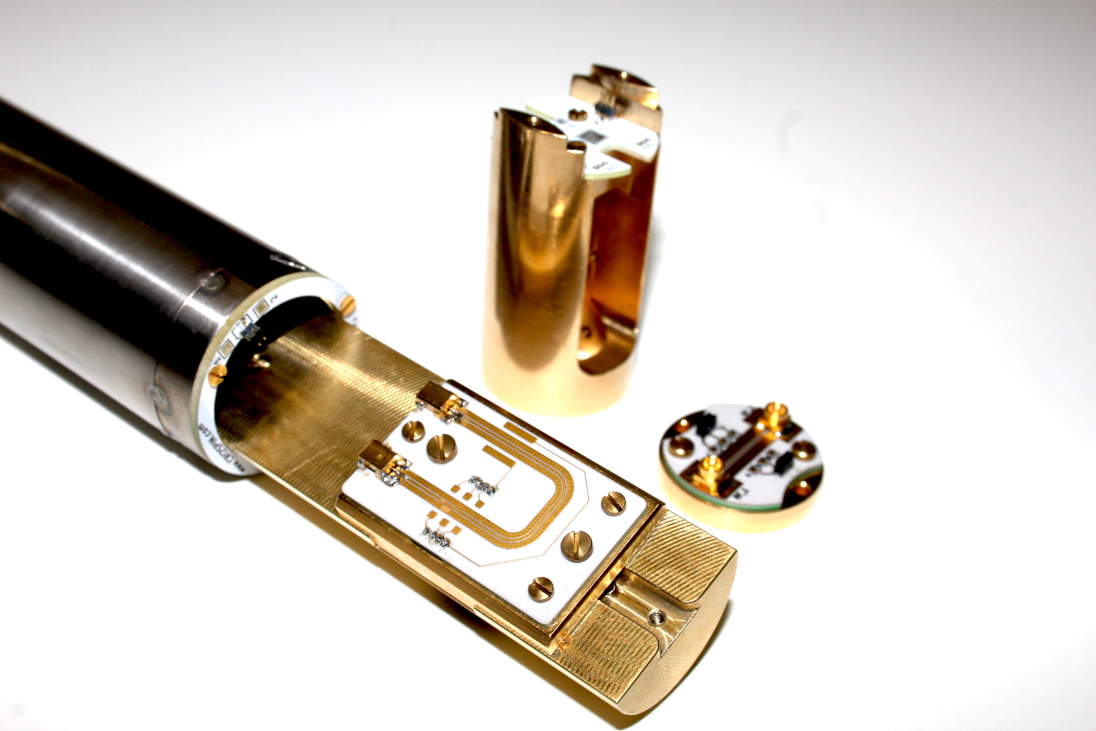
FMR insert: Custom-designed by CRI²SPIN
Cryostat: Provided by Cryogenic Ltd., London
Measurement modes: Field-swept FMR, frequency-swept FMR
Software: Fully integrated, automated measurement & data acquisition
Sample access: Top-loading VTI design
Magnetic field: Superconducting magnet (configurable)
The FMR insert is designed around the Cryogenic Ltd. platform. Compatibility with other cryostat systems may be available upon request — contact us to discuss your existing infrastructure.
Inverse Spin Hall Effect (ISHE) Detection
The Cryo FMR insert optionally integrates electrical contacts for simultaneous Inverse Spin Hall Effect (ISHE) measurements — enabling spin pumping experiments directly within the cryogenic environment. This allows researchers to correlate microwave-driven FMR absorption with the resulting DC or AC voltage signal in a single cooldown, without any sample remounting.
Spin Pumping at Cryogenic Temperatures
In a spin pumping geometry, a ferromagnetic (FM) layer driven at FMR injects a spin current into an adjacent normal metal (NM) layer — typically Pt, W, or Ta. The ISHE converts this spin current into a transverse charge voltage, which serves as a direct, electrical measure of spin-current generation efficiency. Performing these experiments at low temperatures is critical for disentangling proximity effects, magnon lifetime changes, and interface transparency as a function of temperature — all of which are inaccessible at room temperature alone.
Integrated Electrical Contacts in the VTI
CRI²SPIN’s Cryo FMR insert incorporates low-noise electrical wiring routed alongside the RF lines directly into the VTI sample space. Dedicated contact pads on the sample holder allow simultaneous measurement of the ISHE voltage across the NM layer while the FMR signal is acquired. All wiring is thermally anchored at intermediate temperature stages to minimise heat load on the cold stage and ensure stable base temperature operation.
Simultaneous FMR + ISHE Acquisition
Both signals — the FMR absorption (via Lock-In or VNA) and the ISHE voltage — are recorded simultaneously through the integrated CRI²SPIN software environment. This enables direct, field-by-field correlation of spin dynamics and spin transport in a single sweep, significantly reducing measurement time and eliminating systematic errors from sequential measurements.

detection Methods: Lock-In Amplifier & VNA
The Cryo FMR system supports two complementary measurement modalities, allowing researchers to choose the approach best suited to their experimental requirements.
Lock-In Amplifier (Field-Modulation FMR)
In lock-in detection mode, a small field modulation is superimposed on the static bias field, and the transmitted or reflected microwave power is detected phase-sensitively. This yields the derivative of the FMR absorption lineshape (dP/dH), offering excellent signal-to-noise even for small or weakly absorbing samples. The system is compatible with state-of-the-art digital lock-in amplifiers, including in-house developed solutions optimized for low-temperature operation. Lock-in detection is particularly well-suited for precise linewidth analysis, Gilbert damping extraction, and measurements on thin films with low FMR signal amplitude.
Vector Network Analyzer (VNA-FMR)
In VNA-FMR mode, a vector network analyzer drives the microwave excitation and simultaneously measures the complex transmission (S₂₁) or reflection (S₁₁) parameter across a broad frequency range. This allows frequency-swept measurements at fixed field — giving direct access to the FMR dispersion relation and enabling efficient extraction of resonance frequency, linewidth, and group delay in a single measurement sweep. VNA-FMR is especially powerful for mapping spin-wave dispersion, characterizing multimode spectra, and performing broadband characterization without the need for field modulation.
Which method should I use?
Both modes are fully integrated into the CRI²SPIN software environment and can be selected without hardware reconfiguration. As a general guide:
Lock-In FMR VNA-FMR Signal Output dP/dH (derivative) S₂₁, S₁₁ (complex) Sweep type Field-swept Frequency-swept or field-swept Best for Damping, linewidth, thin films Dispersion, broadband, multimode SNR on small samples ★★★★☆ ★★★☆☆ Speed Moderate Fast Get in touch with us to discuss a custom laser configuration tailored to your experimental setup.
rf -SourceS

Precise control of radio-frequency signals is essential for FMR experiments across the full GHz range. The Cryo FMR system supports RF sources with frequency ranges up to 40 GHz (more on request), covering the complete spectrum from low-GHz thin-film FMR to high-frequency spin dynamics in exotic materials. RF signals are routed into the cryostat via low-loss coaxial lines integrated into the VTI, maintaining signal integrity down to base temperature.
Get in touch with us to discuss your specific needs.
Let’s talk
Tell us your specific needs!